Commercial Chain Link Fence in Brodhead, WI: Repair vs Replacement
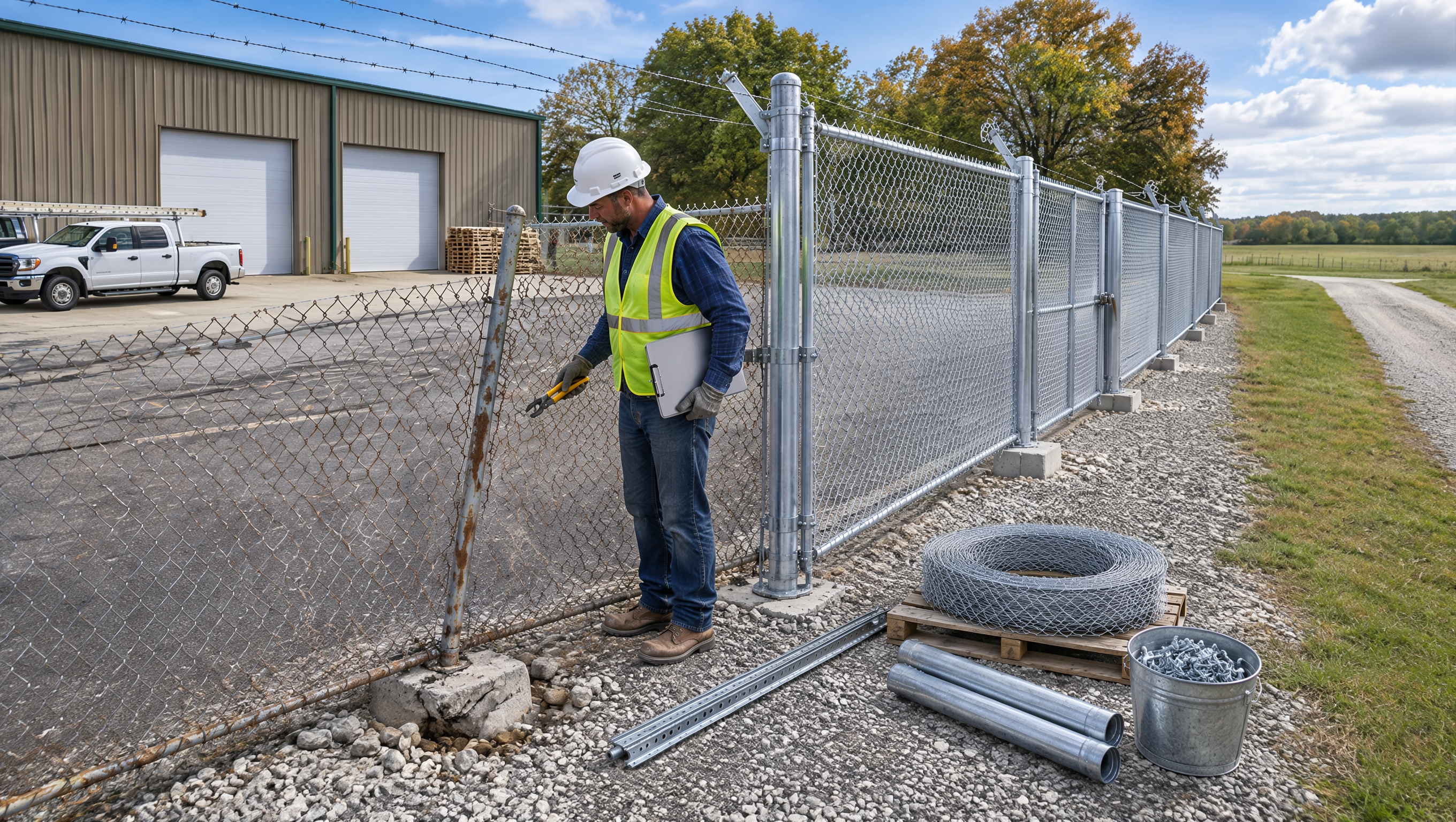
Commercial chain link fencing in Brodhead can often be repaired when damage is limited to a few posts, rails, fittings, or fabric sections. Replacement becomes more practical when corrosion is widespread, several posts are unstable, gates repeatedly fail, or the perimeter no longer fits the property's security and access needs. The best decision comes from evaluating the entire affected section rather than one damaged component.
Start With the Overall Condition of the Fence
Chain link fencing is designed so individual components can be repaired or replaced without rebuilding the entire perimeter.
That makes repair a practical option in many situations.
However, the decision becomes more complicated when several parts are failing at the same time.
Inspect:
Line posts
Terminal posts
Corner posts
Top rails
Chain link fabric
Gates
Tension hardware
A single damaged rail may be straightforward to repair.
A section with leaning posts, loose fabric, corrosion, and repeated gate problems may point toward replacement.
The key question is whether the surrounding fence is still strong enough to support a repair.
Repair Makes Sense When Damage Is Localized
Commercial chain link repair is often practical when the problem is limited to one area.
Examples include:
One bent line post
A damaged top rail
Several broken tie wires
A small torn fabric section
A gate that needs adjustment
Limited corrosion
If the rest of the fence remains stable, replacing only the damaged components can restore the section without unnecessary demolition.
Localized repair can also reduce disruption around active business areas.
This is especially useful when the damaged portion is near a parking lot, service area, or secondary gate that can be worked on without affecting the entire perimeter.
Stable Posts Are the First Requirement
Posts are the structural foundation of chain link fencing.
Before deciding to repair fabric or rails, check whether the posts are still stable.
Look for:
Leaning
Movement near the footing
Exposed concrete
Erosion
Bending
Corrosion near the base
A loose line post may affect only a short section.
A shifting corner or terminal post can cause much more of the fence to lose tension.
If multiple posts are unstable, repairing fabric and hardware first may only provide temporary improvement.
The structural supports should be addressed before the surrounding fence is retensioned.
Chain Link Fabric Can Often Be Reused
Loose or sagging fabric does not automatically require replacement.
If the mesh remains strong, it may often be retensioned once the supporting structure is corrected.
Repair may be appropriate when the fabric has:
Minor distortion
Localized damage
A few broken ties
Limited sagging
Replacement becomes more likely when the fabric is:
Brittle
Heavily corroded
Torn in several places
Permanently stretched
Pulling apart
The condition of the wire matters more than whether the fabric simply looks loose.
Strong mesh can often remain in service after the underlying post or rail problem is repaired.
Bent Rails Are Usually a Sectional Repair
Top rails help chain link fencing maintain alignment.
A bent rail may result from:
Vehicle impact
Fallen branches
Equipment
Storm debris
Snowplows
If surrounding posts and fabric remain sound, replacing the affected rail section may be enough.
Check nearby rail sleeves, fittings, and fabric tension at the same time.
A localized repair makes sense when the damage has not spread.
If several rails are bent across the property, however, the issue may be part of broader deterioration or repeated vehicle impact.
Gate Problems Can Change the Decision
Commercial gates experience more movement and load than fixed fence sections.
Watch for:
Sagging
Dragging
Latch misalignment
Loose hinges
Bent frames
Unstable gate posts
Roller problems on sliding gates
A gate with a worn latch or hinge may be repairable.
Repeated alignment problems may indicate a deeper structural issue.
If the gate posts, frame, and nearby fence section are all deteriorated, rebuilding the entrance may make more sense than continuing to adjust individual components.
Replacement also provides an opportunity to reconsider whether the gate is wide enough for current vehicle traffic.
Widespread Corrosion Can Reduce the Value of Repair
Surface rust on one fitting is different from corrosion throughout the fence.
Inspect:
Post bases
Rails
Gate frames
Tie wires
Bolts
Tension hardware
More serious warning signs include:
Flaking metal
Thinning posts
Holes
Brittle wire
Weak welded connections
If corrosion affects only a few replaceable components, repair may still be practical.
When the same deterioration appears across many posts, rails, and fabric sections, replacement may provide a more dependable long-term solution.
Repeated Vehicle Damage Deserves a Bigger Review
Commercial chain link fencing near active traffic can suffer repeated impact.
High-risk areas often include:
Loading zones
Parking lot corners
Delivery entrances
Equipment routes
Dumpster areas
If the same posts or gate frames are repaired repeatedly, the layout may be contributing to the problem.
Instead of replacing the same components again, consider whether the area needs:
Wider gate access
More turning room
Bollards
Wheel stops
Better traffic routing
Replacement can be a good time to correct the layout rather than rebuilding the same vulnerable configuration.
Drainage Problems Can Affect Both Repair and Replacement
Posts may shift because of ground conditions rather than fence age alone.
Check for:
Standing water
Erosion
Soft soil
Runoff
Exposed footings
Brodhead properties can experience freeze-thaw conditions that make wet or unstable ground more noticeable.
If several posts repeatedly lean in the same area, drainage should be considered before deciding on a permanent fix.
Repairing or replacing the fence without addressing the site condition may allow the same movement to return.
Major drainage work may be separate from the fence project, but it should still influence the repair plan.
Sectional Replacement Can Be the Middle Option
The choice is not always between a small repair and full perimeter replacement.
Sectional replacement can work well when:
Several connected posts are damaged
One gate area repeatedly fails
Corrosion affects one side
Fabric is badly deteriorated in one zone
A vehicle impact damaged multiple components
This allows the strongest sections of the existing fence to remain.
It can also help businesses control project scope while correcting the portion that has reached the end of its useful service life.
The transition between old and new sections should be inspected carefully so the entire perimeter remains aligned.
Full Replacement Makes More Sense When Problems Are Widespread
A larger replacement may be worth considering when the fence has:
Multiple unstable posts
Widespread corrosion
Brittle chain link
Frequent rail failures
Repeated gate problems
Numerous previous repairs
Replacement may also make sense if the current fence layout no longer supports the property's needs.
A business may have changed delivery routes, expanded outdoor storage, or started using larger vehicles since the fence was originally installed.
In those situations, rebuilding the perimeter can solve both structural and operational problems at the same time.
Compare Long-Term Maintenance, Not Just Today's Repair
A small repair may cost less immediately, but businesses should also consider how frequently the fence needs service.
Ask:
Are the same sections failing again?
Are several components aging together?
Is corrosion spreading?
Are gates becoming less reliable?
Does the current layout still work?
Repair remains valuable when it restores a strong surrounding system.
Replacement becomes more attractive when frequent service is only keeping a larger failing system temporarily usable.
Choose the Option That Restores a Dependable Perimeter
Repair and replacement both have a place in commercial chain link maintenance.
Repair works best when damage is localized and the surrounding structure remains sound.
Sectional or full replacement may be more practical when corrosion, unstable posts, gate failures, or repeated damage affect a larger portion of the property.
Rockford Fence provides commercial chain link fence repair, sectional replacement, full replacement, gate repair, security fencing, installation, dumpster enclosures, and other commercial fence solutions.
Contact Rockford Fence to discuss commercial chain link fencing in Brodhead, WI. The team can evaluate the perimeter and help determine whether repair, sectional replacement, or a larger replacement project makes the most sense.
