
Commercial Gate Access in Sycamore, IL: Preparing Entrances for Cold Weather
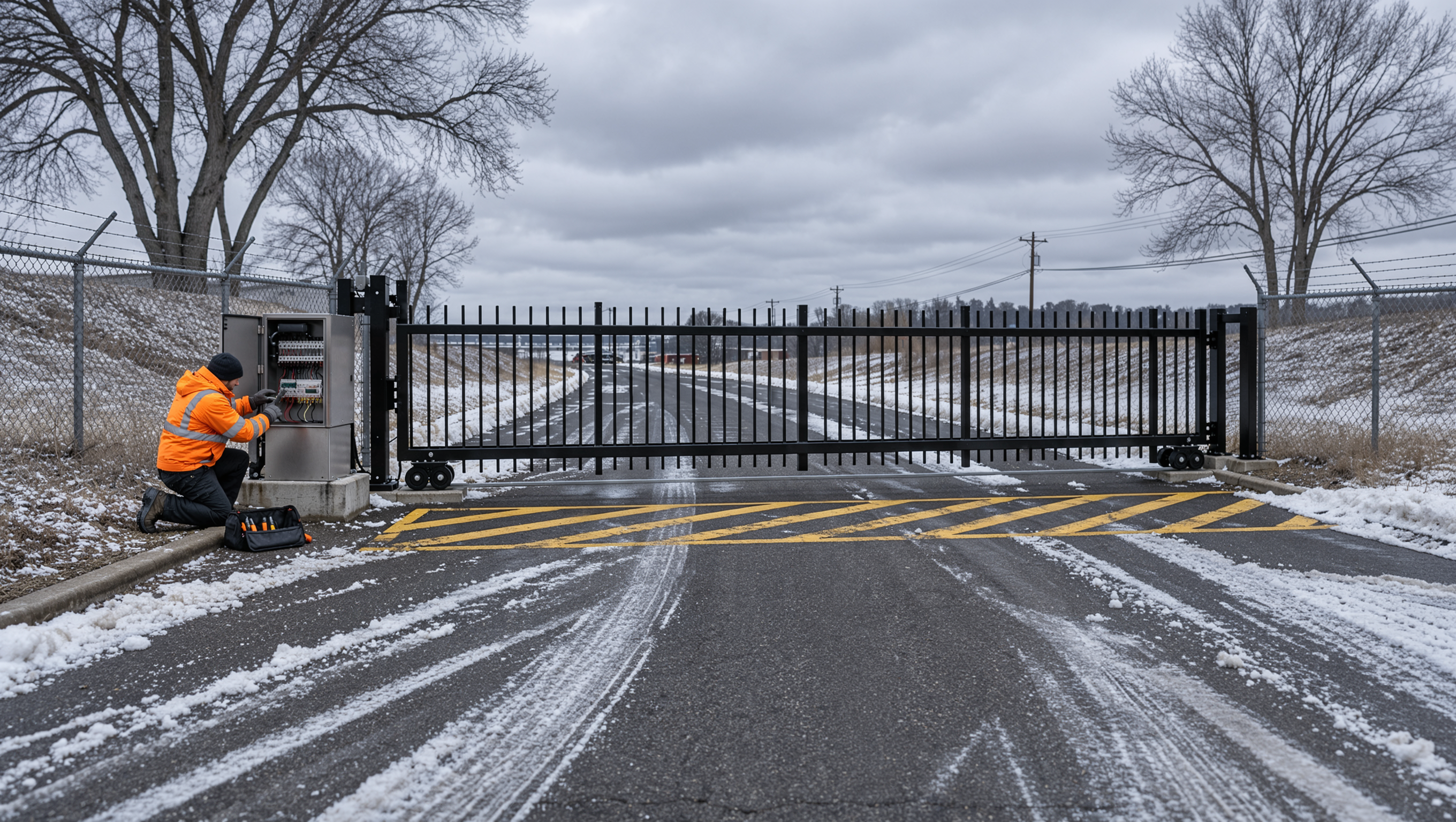
Commercial gate access in Sycamore should be reviewed before colder weather creates problems with alignment, clearance, hinges, rollers, latches, drainage, and snow buildup. Businesses should make sure vehicle and pedestrian gates open smoothly, close securely, and remain clear enough for deliveries, employees, service vehicles, and snow-removal equipment throughout winter.
Start With the Gates That Matter Most
Not every entrance on a commercial property carries the same operational importance.
Begin with gates used for:
Deliveries
Employee access
Equipment
Waste service
Emergency access
Snow removal
Operate each gate several times under normal conditions.
Watch for hesitation, dragging, uneven movement, or difficulty reaching the closed position.
A gate that already feels harder to operate in late fall may become more troublesome once snow, ice, and freezing temperatures affect the entrance.
The busiest access points should receive priority because a failure there can interrupt daily operations quickly.
Check Whether the Opening Is Still Properly Aligned
Stand back and look at the entire gate rather than focusing only on the latch.
Common alignment warning signs include:
One side sitting lower
Uneven spacing between the gate and posts
A frame leaning to one side
Reduced clearance near the ground
A latch no longer meeting naturally
A small shift may come from worn hinges, moving support posts, a bent frame, or roller problems.
Repeatedly adjusting the latch without fixing the cause may provide only temporary improvement.
The gate should reach its closed position naturally before the locking hardware is adjusted.
Inspect Gate Posts Before Winter
Gate posts carry more load and movement than ordinary fence-line posts.
Check the base of each post for:
Leaning
Soil separation
Exposed concrete
Erosion
Corrosion
Vehicle impact
Sycamore can experience freeze-thaw conditions during colder months, so already-unstable soil around a gate post deserves attention.
If the post shifts, the entire entrance can change position.
That may cause dragging, sagging, poor latch alignment, or added resistance on an automated system.
Post stability should be addressed before repeated adjustments are made elsewhere.
Review Swing Gate Hinges
Swing gates depend on hinges to keep the frame level and moving freely.
Inspect hinges for:
Loose fasteners
Excessive movement
Binding
Bent components
Cracks around connections
Corrosion
A worn hinge can allow the gate to drop slightly.
That small change may be enough to reduce ground clearance or move the latch out of position.
The support post should be checked at the same time.
A hinge repair may not last if the post itself continues moving.
Keep Swing Paths Open
A swing gate needs enough room to move through its full opening arc.
Before winter, remove:
Pallets
Branches
Gravel
Equipment
Stored materials
Then look at where snow will likely be pushed.
A gate can be mechanically sound and still become unusable if a snowbank blocks its swing path.
If the frame already passes close to the pavement or ground, correct the clearance problem before snow and ice reduce the available space further.
Inspect Sliding Gate Rollers and Guides
Sliding gates create different cold-weather concerns.
Check:
Rollers
Guides
Stops
Tracks where applicable
Frame alignment
Full travel path
Remove leaves, mud, gravel, branches, and other debris before they freeze into place.
A sliding gate that shakes, grinds, or hesitates may have worn rollers or poor guide alignment.
If the gate still moves roughly after the path is cleared, the mechanical components should be inspected before winter.
Forcing a gate through resistance can create additional wear.
Check Ground Clearance at Vehicle Entrances
Ground clearance often becomes more important during colder weather.
Inspect where the gate passes over:
Asphalt
Concrete
Gravel
Uneven soil
Raised pavement edges
A gate that barely clears the surface in fall may begin dragging once ice or compacted snow accumulates.
Possible causes include hinge wear, post movement, frame damage, or changes in grade.
The underlying issue should be corrected rather than relying on more force to move the gate.
This is especially important at high-use commercial entrances.
Test Latches and Locks
A gate should secure the entrance without being lifted, pushed sideways, or slammed.
Inspect:
Latches
Locks
Strikes
Stops
Handles
Bolts
If the hardware only works when the frame is forced into position, the gate likely has an alignment problem.
The lock should engage naturally when the gate reaches its proper closing point.
Reliable closure becomes even more important during winter when snowbanks, reduced daylight, and difficult access can make normal operations more complicated.
Review Drainage Around the Entrance
Water around a gate can create both structural and access problems.
After rain, look for:
Standing water
Mud
Erosion
Low areas
Runoff toward gate posts
Water may later freeze in the path of the gate.
Repeated moisture can also contribute to soil instability around footings.
If a gate often loses alignment after wet conditions, drainage may be part of the problem.
Major drainage correction may require separate work, but the condition should still be identified during gate maintenance.
Look for Corrosion on Moving Components
Gate hardware may face additional moisture and road salt exposure in winter.
Inspect:
Hinges
Bolts
Gate frames
Roller hardware
Post bases
Welded connections
Surface rust does not always mean a part has failed.
More serious warning signs include:
Flaking metal
Holes
Thinning components
Weak welds
Brittle hardware
Structural corrosion deserves attention before winter because weakened components may not remain dependable under repeated use.
A badly deteriorated hinge, frame, or roller assembly may need replacement rather than another adjustment.
Review Automated Gates Mechanically First
If the property uses automated gates, check the physical gate before focusing on the operator.
An operator may struggle when the gate has:
Poor alignment
Dragging
Worn rollers
Binding hinges
Unstable posts
Debris in the travel path
The gate should move freely before operator-related problems are evaluated.
Once mechanical resistance is ruled out, symptoms such as incomplete closing, unexpected stopping, or inconsistent movement may involve controls, sensors, electrical components, or the operator itself.
Safety devices should not be bypassed.
Problems involving automation or electrical systems may require qualified service.
Review Vehicle Clearance
Cold weather can make already-tight entrances harder to use.
Snowbanks may reduce the usable width of the opening and force trucks closer to gate posts.
Consider the vehicles that use the entrance, including:
Delivery trucks
Trailers
Service vehicles
Equipment
Waste-removal trucks
Snowplows
If drivers regularly pass close to the posts, winter can increase the risk of impact.
Depending on the site, wider gate access, bollards, wheel stops, or additional turning clearance may help reduce damage.
Plan Snow Storage Before the First Major Storm
Snow-removal planning should be part of gate preparation.
Avoid storing snow:
In swing gate arcs
Along sliding gate paths
Against support posts
Around gate stops
Where it narrows vehicle access
Snowbanks can block movement and reduce visibility around entrances.
They may also push trucks and service vehicles closer to the gate structure.
Pedestrian gates should remain clear as well.
The best time to decide where snow will go is before the first major accumulation.
Prioritize Access Problems Before Cold Weather Gets Worse
If several gates need work, prioritize the problems most likely to interrupt operations.
Higher-priority issues generally include:
Gates that do not close
Gates that do not lock
Unstable support posts
Severe dragging
Failed hinges
Worn rollers
Bent frames
Structural corrosion
Minor cosmetic wear can usually be monitored.
The goal is to keep critical entrances usable and secure throughout winter.
Prepare Your Sycamore Commercial Gates for Cold Weather
Commercial gate access depends on stable posts, dependable hardware, proper alignment, clear travel paths, and practical snow planning.
Hinges, rollers, latches, drainage, ground clearance, vehicle access, and automated systems should all be reviewed before freezing conditions become more consistent.
Rockford Fence provides commercial gate maintenance, repair, installation, replacement, chain link fencing, security fencing, dumpster enclosures, and other commercial fence solutions.
Contact Rockford Fence for commercial gate service in Sycamore, IL. The team can inspect entrance alignment, hardware, structural components, and surrounding fence conditions and recommend practical repairs before cold weather makes existing problems harder to manage.
