Fence Repair in Byron, IL: Posts, Panels, Gates & Storm Damage
Most fence damage in Byron, IL — whether from a storm, a hard winter, or years of wear — doesn't require a full replacement. This guide helps homeowners and commercial property owners identify what's actually wrong, what can be repaired, and when the damage is significant enough that replacement is the smarter call. Rockford Fence handles fence repair and replacement throughout Byron and the surrounding northern Illinois region.
Byron Fences Take a Real Beating
Byron sits along the Rock River in Ogle County — a stretch of northern Illinois that delivers genuine Midwest weather in every season. Late-winter ice storms, early spring flooding near the river corridor, high winds through open terrain, and ground that freezes deep every year all work against outdoor fence structures in ways that residents know firsthand.
The result is that fence repair calls in this area tend to spike twice a year — once in early spring after the freeze-thaw cycle has done its work, and again after the summer storm season. Knowing what to look for and how to assess the damage makes it easier to act quickly and avoid letting a small problem grow into a larger one.
Starting With a Proper Damage Assessment
Before calling for repairs — or assuming a fence needs to be replaced — it's worth doing a systematic walk of the fence line. Most homeowners and property owners can identify the primary issues with a close visual inspection. What you're looking for:
Posts: Are any leaning, heaved out of the ground, or rotted at the base? Does the lean follow a pattern across multiple posts, or is it isolated to one area?
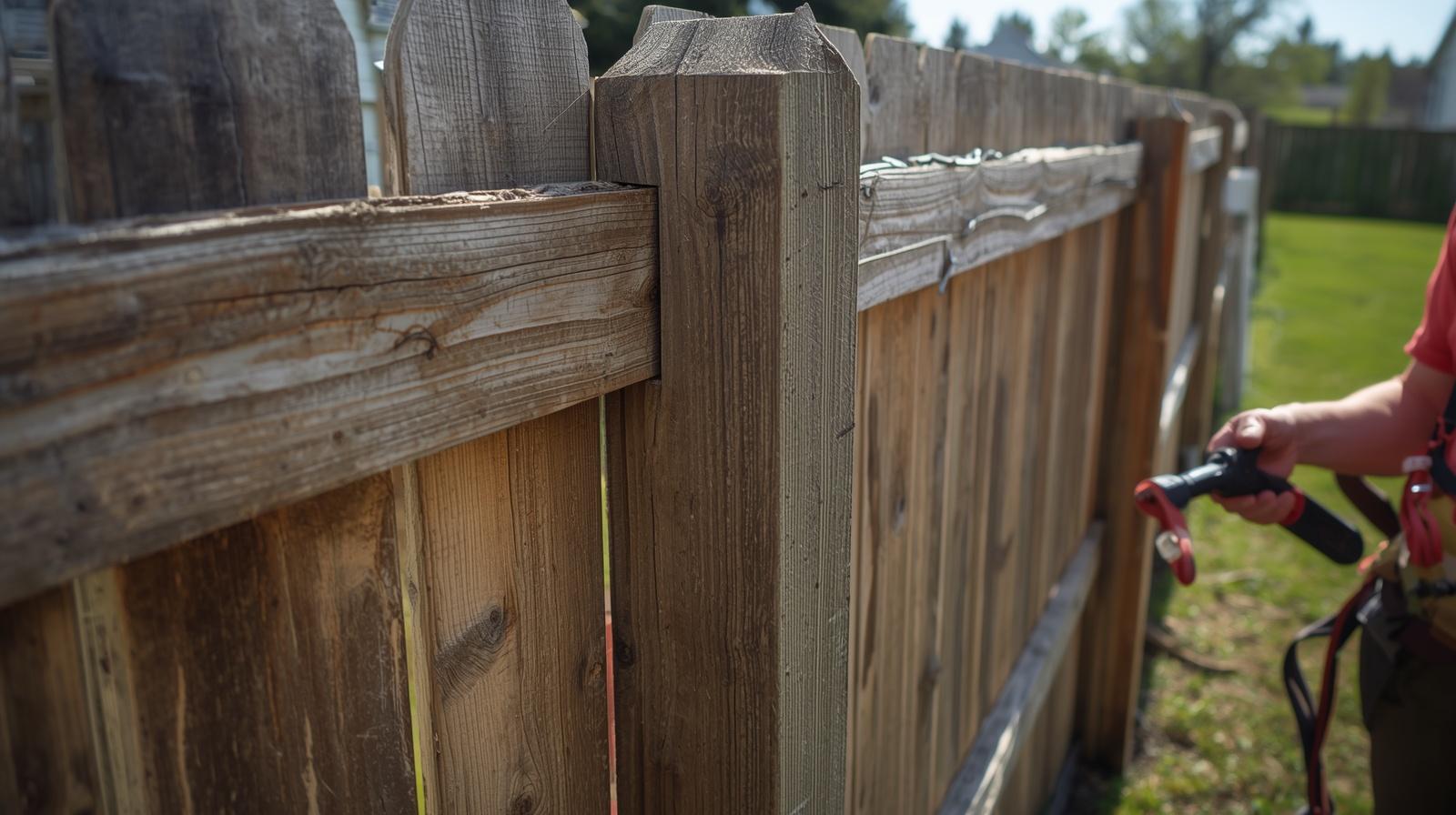
Panels and boards: Are individual boards cracked, split, or missing? Is the damage isolated or spread across multiple sections?
Rails: Are horizontal rails bent, cracked, or pulling away from the posts?
Gates: Does the gate swing freely and latch reliably? Is it dragging, binding, or sitting noticeably out of square?
Hardware: Are hinges, latches, tension bands, or other hardware components broken, missing, or visibly corroded?
Mesh (for chain link): Is the mesh torn, sagging, or showing widespread rust?
Documenting what you find — even with phone photos — is useful before a contractor visit and for insurance claims if storm damage is involved.
Post Repairs: The Foundation of the Problem
Post failures are the most structurally significant fence repair in northern Illinois. Everything else — panels, rails, gates — depends on posts that are plumb, solid, and properly anchored.
Frost Heave
The frost line in the Byron area runs 42 inches or deeper. Posts that were originally set above that depth — or in deteriorated concrete footings — are vulnerable to heaving each winter as the ground freezes and expands. A heaved post tilts, pulls the attached panels with it, and stresses connection hardware along the whole section.
A post that has heaved but is otherwise structurally sound can often be reset. The process involves excavating around the base, removing or breaking out the old footing, re-plumbing the post, and resetting it in fresh concrete that properly reaches below the frost line. Done correctly, this is a lasting repair.
A post that has rotted at or below grade — common with wood fence posts, particularly older pressure-treated pine that has lost its preservative effectiveness — needs to be replaced, not reset. There is no surface treatment that restores structural integrity to wood that has rotted through at the base.
Impact and Lateral Damage
Posts bent or snapped by vehicle contact, fallen trees, or storm debris need to be replaced. Attempting to straighten a steel post that has been significantly bent introduces metal fatigue that will lead to failure under far less force than the original impact. A wood post that has cracked or split at the base under lateral load is similarly a replacement item.
Panel and Board Repairs
For wood privacy fences — the most common residential fence type in Byron neighborhoods — panel and board damage is often the most visible repair need after a storm or a hard winter.
Isolated Board Replacement
Individual cracked, split, warped, or missing boards can be replaced without disturbing the surrounding fence structure, as long as the posts and rails are sound. This is one of the most cost-effective repairs available — targeted, fast, and it extends the fence's useful life without a full replacement investment.
The key to a clean board replacement is matching the species, dimensions, and profile of the existing boards. A mismatched replacement board will weather differently and stand out. A good contractor will source matching material before the repair begins.
Section Replacement
When damage is concentrated in a defined section — a run of boards between two posts that caught a fallen branch, for example — replacing that full section rather than individual boards is often cleaner and more economical. The posts and rails are retained if they're sound; only the damaged panel material is replaced.
Rail Damage
Horizontal rails that have split, cracked, or pulled away from the posts need to be replaced. A rail that is merely loose at the connection point — where the fastener has backed out over time — can often be re-secured with new hardware. A rail that has split along its length or cracked at the post connection is a replacement item.
Chain Link Repairs: Mesh, Rails, and Hardware
Chain link fencing is repairable in a way that few other fence materials are. Its component-based construction means individual elements can be addressed without pulling out the entire fence.
Mesh Damage
Torn, cut, or badly bent chain link mesh can be replaced section by section. The damaged portion is cut out, a matching section of new mesh is woven in or attached with hog rings and tie wires, and the tension is restored. For the repair to perform correctly, the replacement mesh should match the original in gauge, mesh size, and coating — galvanized to galvanized, vinyl-coated to vinyl-coated.
Top Rail and Line Post Damage
A bent or broken top rail section can be replaced without touching the posts or the mesh below. The affected rail section is removed, a matching replacement is cut and fitted, and the mesh is re-attached. Line posts that have been bent by impact or have rusted through at grade need to be replaced — and the new post needs to be set in concrete at proper depth.
Hardware Replacement
Tension bands, brace bands, rail end cups, post caps, and tie wires are all standard replacement items. These components fail over time from corrosion, freeze-thaw cycling, and general wear. Replacing worn hardware on an otherwise solid chain link fence is often the simplest and most cost-effective repair available.
Gate Repairs: The Most Common Service Call
Gates are the hardest-working component of any fence system. They swing, they absorb wind load, and they take the mechanical stress of daily use that the rest of the fence never sees. Gate problems are the most frequent repair call across every fence material type.
Sagging Gates
A gate that sags — dropping at the latch end and dragging on the ground — is almost always a hinge problem, a post problem, or both. If the post is still plumb and the gate frame is square, new heavy-duty hinges and hardware adjustment can restore function. If the gate post has leaned or the footing has failed, the post needs to be reset before the gate will hang correctly. Adjusting the gate without addressing a compromised post is a temporary fix at best.
Gates That Won't Latch
A gate that won't latch reliably has usually shifted out of alignment — either the gate itself has racked slightly out of square, or the post has moved enough to shift the latch fork away from the receiver. Minor alignment problems can often be corrected with hardware adjustment. Significant misalignment usually points to a post problem that needs to be addressed at the foundation level.
Bent Gate Frames
A gate frame that has been bent — by vehicle contact, by a fallen tree, or by years of wind stress on a gate that was undersized for the opening — is a replacement item. A welded steel or aluminum gate frame that has deformed will not function cleanly after straightening. The right answer is a new gate built to the correct specifications for the opening and the anticipated use load.
Storm Damage: What to Check After a Major Event
Byron's location along the Rock River corridor and the open terrain of Ogle County makes it susceptible to the kind of high-wind events that can take down fence sections, snap posts, and lift panels entirely. After a significant storm, a systematic damage assessment should cover:
Downed sections — fence panels or entire sections that have been knocked flat by wind, falling branches, or debris impact
Snapped or cracked posts — particularly wood posts that may have snapped at or near grade under lateral wind load
Shifted gate posts — gate posts that have moved under the wind load transferred through a closed gate
Debris lodged in the fence — branches, roofing material, and other debris that can damage mesh or panels if not removed promptly
Pulled fence line — where a downed section has pulled adjacent panels and posts out of alignment
If damage is significant and a homeowner's insurance claim is involved, document everything with photos before any cleanup or temporary repairs begin. A contractor can provide a written repair estimate for the claims process.
When Repair Crosses Over Into Replacement
Most fence damage is repairable. But there are conditions where continuing to repair an aging fence stops making economic sense.
Replacement is the more practical path when:
Multiple posts have failed across the fence line — either from frost heave, rot, or rust — indicating systemic deterioration rather than isolated damage
Repair costs approach 50% or more of replacement cost — at that level, a new fence delivers better long-term value and resets the maintenance clock
The fence is at end of life — a wood fence beyond 15–20 years with significant rot, a chain link fence with widespread corrosion, or an ornamental fence with structural rust throughout is past the point where repairs provide meaningful return
Storm damage has affected a large percentage of the fence line — replacing a fence that has been substantially destroyed is often cleaner and more cost-effective than piecing together a heavily repaired structure
An honest contractor will tell you which side of that line your fence falls on — and won't push a full replacement on a fence that only needs targeted repairs.
Residential and Commercial Fence Repair in Byron
Rockford Fence handles fence repair for homeowners, commercial property owners, property managers, and farm and rural property owners throughout Byron, IL and surrounding Ogle County communities. We work across all fence materials — wood, chain link, ornamental steel, aluminum, and vinyl — and provide a clear assessment of what needs to be done before any work begins.
Whether you're dealing with storm damage that needs prompt attention or a fence that has been gradually deteriorating through several winters, we'll give you a straight answer on the right path forward.
Contact Rockford Fence for Fence Repair in Byron
Don't let a repairable fence problem become a replacement-level problem through delay. Rockford Fence serves Byron and the surrounding northern Illinois region — and we're ready to assess your fence, provide an honest estimate, and get the work done right.
Visit rockfordfence.net or call us today to schedule your fence repair assessment.
