Security Fence Options in Beloit, WI: Chain Link, Steel & Aluminum
Beloit, WI property owners have three strong security fencing options — chain link, steel ornamental, and aluminum — each suited to different security levels, budgets, and property types. This guide breaks down how each material performs, where it fits, and what to consider before committing. Rockford Fence installs security fencing for residential and commercial properties throughout Beloit and the surrounding Wisconsin and Illinois region.
Security Fencing Is About More Than Keeping People Out
When property owners in Beloit start thinking about security fencing, the first instinct is often to focus on height and intimidation factor. Those matter — but effective security fencing is really about access control, deterrence, perimeter definition, and long-term reliability.
A fence that looks imposing but fails at the post level after two Wisconsin winters isn't doing its job. A fence that's over-specified for a property's actual risk profile wastes budget that could go toward better access control hardware or lighting. The right security fence is the one that matches the real needs of the property — and performs consistently through southern Wisconsin's four-season climate.
Beloit sits at the Illinois-Wisconsin border and covers a diverse mix of residential neighborhoods, commercial corridors, industrial properties, and institutional facilities. Security fencing needs vary significantly across those property types, and so does the right material choice.
What to Define Before Choosing a Security Fence
Before selecting a material, it's worth being specific about what you're actually trying to accomplish. A few questions that shape the decision:
What is the primary threat? Casual trespass, opportunistic theft, vandalism, vehicle intrusion, or unauthorized access to a controlled area all call for different levels of perimeter strength.
Does the fence need to be visible through? Open perimeters allow cameras and staff to monitor activity outside the fence line. Screened perimeters block sightlines but can create concealment opportunities.
What is the required height? Six feet handles most residential and light commercial applications. Eight to ten feet — with wire extensions — is standard for industrial and high-security sites.
What access points are needed? Gate type, frequency of use, and access control hardware are often as important as the fence itself.
Are there local ordinances or HOA requirements? Beloit and Rock County have zoning regulations that govern fence height, placement, and in some cases material type — particularly for properties in commercial or industrial zones.
Getting clear on these before specifying a fence saves both money and time.
Chain Link: The Security Workhorse
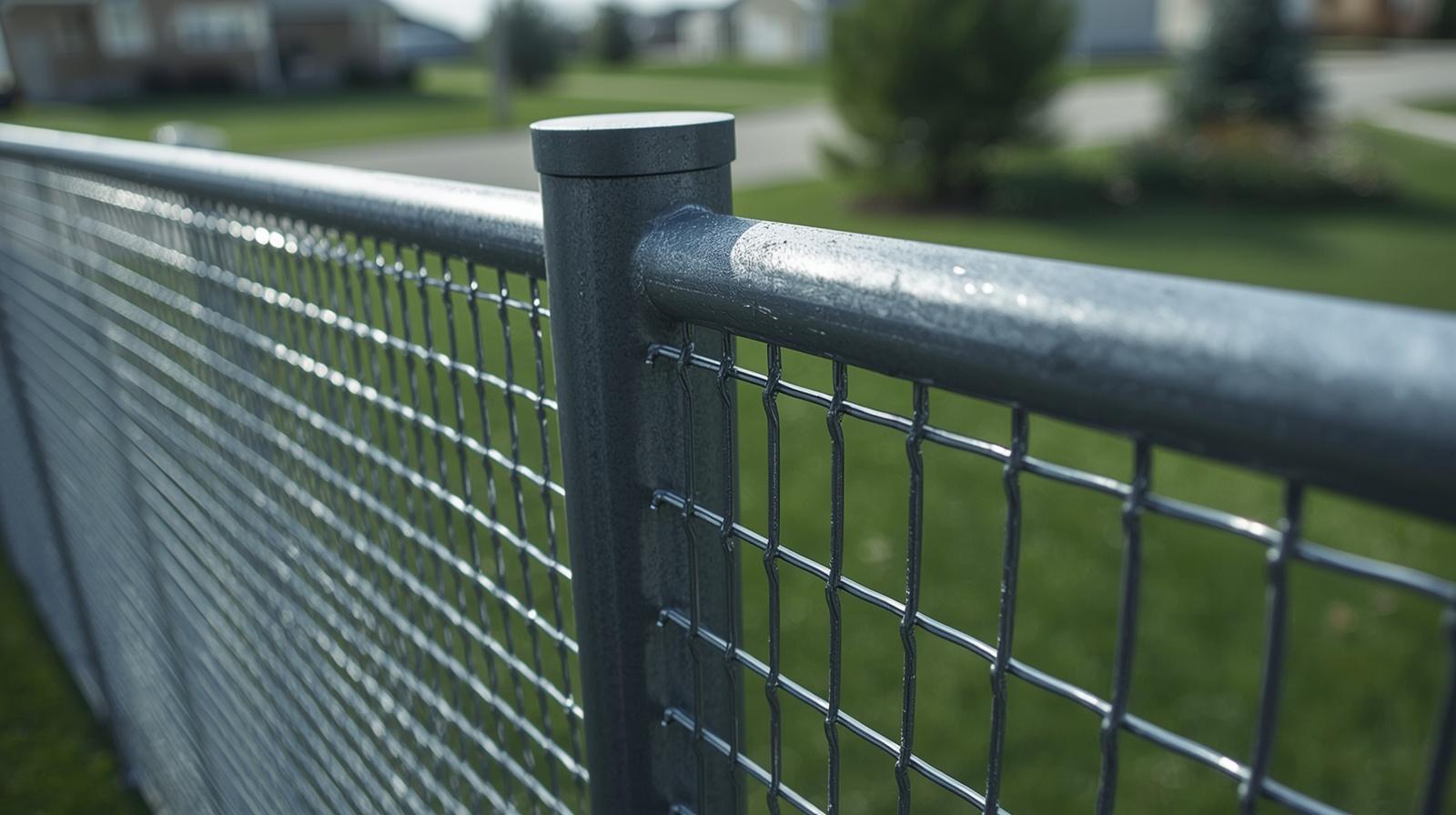
For most commercial, industrial, and institutional security applications in Beloit, heavy-gauge chain link is the practical foundation of a perimeter security system. It covers large areas cost-effectively, holds up through Wisconsin winters without demanding significant maintenance, and can be configured to nearly any security specification.
What Makes Chain Link Security-Grade
Not all chain link is the same. Residential-grade chain link — the lightweight mesh common on backyard fences — is not a security product. True security-grade chain link is defined by several key specifications:
Mesh gauge — 6-gauge and 9-gauge wire is substantially harder to cut or deform than the 11-gauge mesh used in residential applications
Post size and spacing — heavier line posts at tighter spacing resist lateral force and vehicle impact better than standard residential specs
Height — security chain link typically starts at 8 feet; high-security applications run 10–12 feet
Topping — barbed wire (three-strand or more) and razor wire coils add a meaningful deterrent above the fence line
Coating — galvanized or vinyl-coated finishes resist the rust and corrosion that Wisconsin's wet springs and road salt accelerate
Best Applications in Beloit
Chain link security fencing is the right call for:
Industrial facilities and manufacturing perimeters
Equipment yards, storage areas, and staging lots
Trucking, logistics, and transportation properties
Utility infrastructure and substations
Vehicle impound and fleet storage
Schools and institutional campuses requiring large-perimeter coverage
Commercial properties where budget efficiency over long fence runs is a priority
For properties that need visual screening alongside security, chain link with privacy slats or a solid lower panel insert provides containment and concealment without switching to a fully opaque system.
Steel Ornamental Fencing: Security With a Professional Appearance
Where security and appearance both matter — office campuses, healthcare facilities, mixed-use developments, and retail properties — steel ornamental fencing delivers perimeter integrity without the industrial look of chain link.
Security Advantages of Steel Ornamental
Steel ornamental fencing earns its security value through construction, not just appearance:
Solid steel pickets and rails resist bending and cutting far better than aluminum
Vertical picket design eliminates horizontal footholds, making the fence genuinely difficult to climb
Anti-climb and anti-cut picket tops — spear points, finials, and inward-angled extensions — add deterrence at the top of the fence line
Heavy-gauge steel construction means a determined breach requires time, noise, and tools — all of which increase detection risk
Powder coat or galvanized finishes protect against Wisconsin's freeze-thaw cycling and road salt exposure
Where Steel Ornamental Fits in Beloit
Steel ornamental fencing is well-matched for:
Corporate office campuses and business parks
Hospitals, medical campuses, and assisted living facilities
Schools, childcare centers, and educational properties
Municipal and government facilities
Multifamily residential and mixed-use developments
Retail centers and commercial properties where streetside appearance affects business
The trade-off is cost. Steel ornamental carries a higher price per linear foot than chain link. For long industrial perimeters, chain link almost always delivers better value per foot of coverage. For shorter frontage runs and properties where presentation matters, the investment in steel is typically justified.
Steel vs. Wrought Iron
True wrought iron fencing is uncommon in modern installations — most ornamental steel fencing today is mild steel or tubular steel, powder-coated or galvanized. The distinction matters because modern steel fabrication delivers consistent strength and finish quality that hand-forged wrought iron couldn't always guarantee. When contractors or suppliers reference "ornamental iron," they are almost always referring to steel.
Aluminum: Where It Fits in a Security Context
Aluminum fencing is a legitimate option for specific security applications — but it's important to be precise about what it can and cannot do.
Where Aluminum Works for Security
Aluminum provides reliable perimeter definition and a meaningful deterrent against casual trespass. Its powder-coated ornamental picket design is difficult to climb casually, and it holds up through Wisconsin winters without rusting — a genuine advantage over steel in high-moisture environments where maintenance budgets are limited.
Aluminum is a practical security choice for:
Residential properties where boundary definition and deterrence are the goals
Pool enclosures where code compliance and visibility are required
Commercial properties where a finished appearance matters and the security threat is low-to-moderate
HOA and subdivision perimeters where ornamental style is specified
Where Aluminum Falls Short
Aluminum should not be specified as the primary security material for properties with a genuine forced-entry risk. The material dents and bends under sustained pressure, and heavier-gauge chain link or steel provides significantly more resistance to cutting and deformation. For industrial sites, high-value storage, or any property where a determined breach is a realistic threat, aluminum is not the right perimeter material.
The honest position: aluminum is a boundary fence with security benefits, not a security fence with aesthetic benefits. That distinction matters when the stakes are real.
Gates: Where Security Perimeters Succeed or Fail
A fence perimeter is only as secure as its access points. Gates that are undersized, lightly built, or equipped with inadequate hardware undermine everything the fence accomplishes.
For commercial and industrial properties in Beloit, gate selection should be driven by actual use patterns and access control requirements:
Slide gates are the standard for commercial vehicle entries. They roll parallel to the fence line, require no swing clearance, and handle high daily traffic volume efficiently. Cantilever slide gates — which ride on a bottom rail rather than a ground track — are preferred for properties with rough surfaces, heavy truck traffic, or significant winter snow and ice accumulation.
Swing gates work well for lower-traffic vehicle entries where swing clearance is available. Simpler mechanically than slide gates, with fewer moving parts that require maintenance.
Pedestrian gates should be self-closing and self-latching on any security perimeter. A pedestrian gate that props open or doesn't latch reliably is a recurring access control problem.
Access control hardware — keypad entry, card readers, intercom systems, and automatic gate operators — turns a physical barrier into a controlled access point. The hardware investment is often as important as the gate itself for properties with genuine security requirements.
Barbed Wire and Razor Wire in Beloit
Barbed wire and razor wire extensions are common on industrial and utility perimeters in the Beloit area. Before specifying either, confirm compliance with local zoning ordinances in Beloit and Rock County — some commercial zones have restrictions on visible wire topping, particularly for properties adjacent to public streets or pedestrian areas.
Barbed wire is standard on agricultural and light industrial fences. Razor wire coils are used on higher-security applications and are subject to more frequent local restrictions. A contractor familiar with Rock County requirements will know what's permitted for your specific property type and zone before installation begins.
Wisconsin Frost Depth and Post Requirements
Southern Wisconsin's frost line runs 48 inches — deeper than the 42-inch depth typical of northern Illinois. For security fencing, which carries heavier loads than residential fence systems, post installation needs to account for both frost depth and the additional structural demands of taller fence heights, gate operators, and barbed wire extensions.
Security fence posts in the Beloit area should be:
Set to a minimum of 48 inches depth — deeper on gate posts and corner posts
Installed in properly sized concrete footings matched to post gauge and fence height
Specified in heavier post dimensions than residential applications — 2-3/8" and 2-7/8" line posts for commercial chain link; 4" or larger for gate and corner posts
Engineered to handle gate operator load on automated entry points — undersized gate posts are the most common source of commercial gate failure
Getting the foundation right is what separates a security fence that performs for decades from one that starts creating problems within a few seasons.
Serving Commercial and Residential Properties Throughout Beloit
Rockford Fence installs chain link, steel ornamental, and aluminum security fencing for residential and commercial properties throughout Beloit, WI and the surrounding region on both sides of the state line. We work with homeowners, business owners, property managers, facility managers, and commercial developers — and we spec fencing systems to the actual security requirements and site conditions of each property.
Whether you need a full commercial perimeter installation, a security gate upgrade, or a residential boundary fence that provides genuine deterrence, we'll give you an honest assessment and a clear estimate.
Contact Rockford Fence for a Security Fencing Consultation in Beloit
If you own or manage a property in Beloit, WI and are evaluating your security fencing options, Rockford Fence is ready to help. We'll walk you through the right material and system for your specific property — without overselling or under-specifying.
Visit rockfordfence.net or call us today to schedule your free security fencing consultation.
